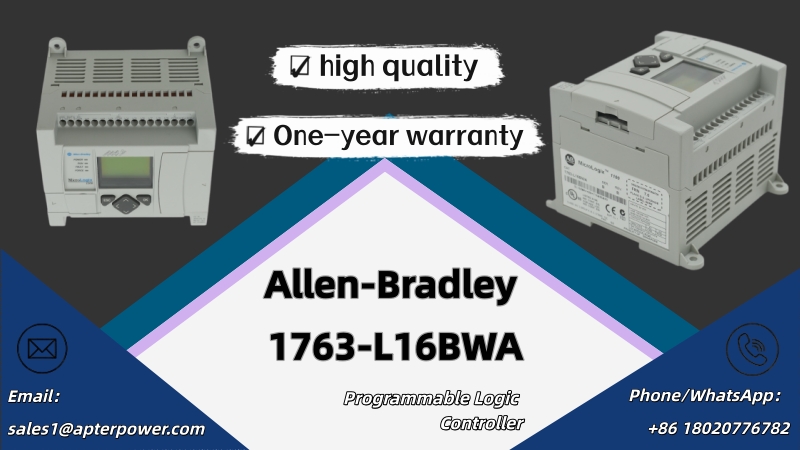
The Allen-Bradley 1763-L16BWA has been used in industrial control systems for many years. As part of the MicroLogix 1100 family, this compact PLC found its way into machine control, material handling, packaging equipment, pumps, small process systems, and many other automation applications.
There is one important issue for plants still running this controller: the MicroLogix 1100 is discontinued.
Rockwell Automation discontinued the 1763-L16BWA on April 30, 2022, which means users maintaining older equipment now have a decision to make. Some plants want to keep an existing machine running and simply need another 1763-L16BWA. Others are looking at a longer-term PLC upgrade or migration to a newer control platform.
Neither approach is right for every application. Before replacing a failed controller or changing an existing PLC system, it is worth understanding exactly what you have, what needs to remain compatible, and how much downtime the plant can accept.
Here are seven things to consider when looking for an Allen-Bradley 1763-L16BWA replacement.
1. Confirm That Your Controller Is Actually a 1763-L16BWA
Start with the label on the existing PLC.
This sounds simple, but MicroLogix 1100 controllers were available in several versions, including the 1763-L16AWA, 1763-L16BWA, 1763-L16BBB, and 1763-L16DWD. They may look similar at first glance, but their power and I/O arrangements are not the same.
The 1763-L16BWA MicroLogix 1100 uses 120/240V AC input power. It has 10 digital inputs for 24V DC signals, two embedded 0–10V analog inputs, and six relay outputs. The controller also includes an Ethernet port and an RS-232/RS-485 combination serial port.
These details can make a real difference when you’re replacing a PLC in an existing control panel. Before buying another unit, check the label on the old controller and write down the full catalog number. A quick photo helps too, especially if you need to send the information to a supplier.
While you’re there, take a look at the expansion I/O and the connections already in use. Is the machine communicating over Ethernet? Is anything connected to the serial port? These are easy things to miss when you’re trying to get a machine back online quickly.
With older Allen-Bradley PLC systems, two controllers can look almost identical but still be different where it matters. Checking the exact Allen-Bradley PLC part number and existing hardware before ordering a replacement can save you from buying the wrong unit and adding more downtime to an already urgent repair.
2. Decide Whether You Need a Direct Replacement or a PLC Migration
Once you know the existing controller is a 1763-L16BWA, the next question is what you actually want to achieve.
If a production machine needs to be back online quickly, sourcing another 1763-L16BWA replacement PLC may be the most practical short-term option. Keeping the same controller can reduce the amount of electrical and software work required, particularly when the machine has been running reliably for years and no major upgrade is planned.
A migration is a different project.
Rockwell Automation recommends moving users of discontinued MicroLogix 1100 controllers toward its Micro800 control platform. That can make sense for a machine that will remain in service for many years, but it should not be treated as a simple one-for-one module swap.
The existing PLC program, I/O requirements, communication interfaces, panel layout, connected equipment, and commissioning work all need to be considered.
This is why searches for MicroLogix 1100 replacement can lead to two very different answers. One customer may need an obsolete 1763-L16BWA immediately to restart a machine. Another may be planning a full PLC modernization or Micro800 migration during a scheduled shutdown.
Before buying anything, decide which situation applies to your plant.
3. Check the Existing I/O Before Choosing a Replacement
I/O compatibility is one of the most important parts of any PLC replacement.
The 1763-L16BWA provides 10 digital inputs, including high-speed input capability, two embedded analog voltage inputs, and six relay outputs. If the machine also uses MicroLogix expansion I/O, those modules need to be included when reviewing the existing system.
For a direct 1763-L16BWA replacement, document how the current inputs and outputs are being used before removing the old controller. Wiring labels, electrical drawings, photographs, and PLC documentation can save considerable time during installation.
For a migration to another PLC family, the process requires more planning.
The new controller needs enough digital and analog I/O for the application, but matching the number of points is only the beginning. Signal type, voltage, output type, response requirements, expansion capacity, and field wiring should all be checked.
Relay outputs are particularly worth noting because the 1763-L16BWA has six relay outputs. Moving to a controller with a different output arrangement may require changes elsewhere in the panel.
This is also a good time to review whether the machine has changed since it was originally built. Additional sensors, actuators, safety devices, or production requirements may mean the replacement system should have more capacity than the original MicroLogix 1100 PLC.
4. Don’t Overlook Ethernet and Serial Communication
A PLC can fit perfectly in the panel and still be the wrong replacement if it cannot communicate with the rest of the machine.
Communication is one reason the MicroLogix 1100 remained useful in many legacy automation systems. The 1763-L16BWA provides a 10/100 Ethernet port and an isolated RS-232/RS-485 combination port. Supported communication options include EtherNet/IP messaging, DF1, DH-485, Modbus RTU, and ASCII.
Before replacing the controller, find out which of those connections your machine actually uses.
The Ethernet port may be communicating with another controller, an HMI, programming equipment, or other devices on the industrial network. The serial connection may be talking to a drive, barcode reader, weighing device, legacy HMI, or another piece of automation equipment.
For a direct 1763-L16BWA replacement, documenting IP addresses and communication settings before removing the existing PLC can make commissioning much easier.
For a PLC migration, communication compatibility deserves even more attention. A newer controller may support modern industrial Ethernet very well but handle an older serial protocol differently. In some applications, additional hardware or program changes may be required.
If communication is overlooked until installation day, a seemingly simple MicroLogix 1100 upgrade can quickly turn into a much longer shutdown.
5. Back Up the PLC Program Before Replacing Anything
If the existing controller is still accessible, back up the application before you remove it.
For many older machines, the PLC itself may be replaceable, but the original program is much harder to recreate. The logic may contain years of machine-specific changes that are not reflected in the original drawings or documentation.
A backup should be treated as part of normal legacy PLC maintenance, not something to think about only after a controller fails.
Where possible, confirm that you have the correct program version and make a record of important controller settings, communication parameters, timer or counter values where relevant, and any information needed to return the machine to operation.
If you are installing another 1763-L16BWA, having a verified backup can make the replacement process much smoother.
If you are migrating away from the MicroLogix platform, the existing program is still valuable. It gives the engineer responsible for the PLC migration a clear view of the original machine sequence, interlocks, alarms, I/O usage, and communication logic.
This is one area where a few minutes of preparation can save hours later.
6. Buying a Discontinued 1763-L16BWA: What Should You Check?
Since the Allen-Bradley 1763-L16BWA is discontinued, buyers may find different product conditions on the industrial automation spare parts market.
Depending on availability, a unit may be offered as new surplus, used, or refurbished. Do not look at price alone.
Ask the supplier about the actual condition of the controller, whether it has been tested, what warranty is offered, whether the item shown is actually in stock, and how quickly it can be shipped. For urgent maintenance work, actual availability can matter more than saving a small amount on the purchase price.
Photos are useful as well. If possible, ask for images of the actual unit and label rather than relying only on a generic catalog picture.
The supplier should also understand exactly which part you are asking for. Providing the full catalog number 1763-L16BWA, along with a photo of your existing controller, makes identification easier.
This is especially useful when sourcing obsolete Allen-Bradley PLC parts, because similar model names can lead to mistakes.
For plants that maintain several older machines, keeping a tested spare controller may also be worth considering. Waiting until the only PLC on a critical machine fails can turn a normal spare-parts purchase into an urgent search for a discontinued component.
7. When Is It Better to Upgrade Instead of Replace?
Keeping a legacy PLC running can make good business sense, particularly when the machine is stable, spare parts are available, and changing the control system would create unnecessary downtime.
But there is a point where migration deserves serious consideration.
If 1763-L16BWA controllers are becoming difficult to source, other MicroLogix components are also aging, or the machine needs new networking, data collection, or control capabilities, a PLC upgrade may provide better long-term value.
The same applies when a production line has several aging controllers and maintenance teams are spending more time finding discontinued automation parts.
Rockwell Automation currently encourages MicroLogix 1100 users to consider the Micro800 platform. For a plant planning this type of MicroLogix to Micro800 migration, the project should include the controller, I/O, communications, software conversion, electrical changes, testing, and commissioning rather than focusing on the CPU alone.
There is no need to migrate simply because the 1763-L16BWA has been discontinued. Many facilities continue operating legacy PLC systems because the equipment still performs the job it was designed to do.
The practical question is whether maintaining the existing system still makes sense for your production needs, spare-parts strategy, and expected machine life.
Final Thoughts
The Allen-Bradley 1763-L16BWA may be discontinued, but there are still plenty of MicroLogix 1100 systems running in plants today. If the machine is doing its job and you simply need to get it running again, replacing a failed controller with another 1763-L16BWA can make more sense than rebuilding the control system.
An upgrade is worth thinking about when spare parts are getting harder to find or the machine is due for a larger modernization project. In that case, moving from MicroLogix 1100 to Micro800 may be one option. Either way, check the I/O, communications, existing PLC program, and catalog number before making a decision. A replacement that looks right on the outside may not be right for the application.
Still trying to find a 1763-L16BWA replacement? We supply MicroLogix 1100 controllers as well as other discontinued Allen-Bradley PLC parts and industrial automation spare parts. We also stock PLCs, I/O modules, drives, and communication modules from a range of automation brands. Contact us for current stock, pricing, or help checking the part you need.
We stock the 1763-L16BWA and a wide range of automation parts from leading brands, including discontinued and hard-to-find models. Contact us for reliable products, competitive pricing, and current availability.
Sales manager:Jim Pei
Email:sales1@apterpower.com
Wechat: ZXH18020776782
Phone/WhatsApp:+86 18020776782